| |
|
|
 |
|
|
A few thousand years ago, as the Ice Age receded north to unveil the Northern European continent, a secluded lake at the base of one of Europe's most rich and fertile valleys was formed. As water and ice was swept down into the basin, vast quantities of herbs, plants, reeds, and blooms growing in the valley were carried into the lake and left to settle to the bottom. Hundreds of varieties, over hundreds of years slowly settled. The lake had no opening - no outlet. The valley was closed forever.
Through seasonal changes of time, this rich organic sediment began to metamorphose. Subject to the action of the lake's natural micro-flora, the elements of the herbs were broken down into fine substances - active bio-structures kept intact, and slowly distilled to form one of the richest and most active organic deposits in the world. As time progressed, pure spring water rising from deep within the earth kept this unique substance 'alive', pure, and in the exact form that nature prepared it. The lake is now Moor. |
|
|
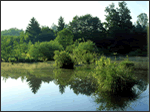 By definition, Moor means 'peat marsh'. And while not totally inapropriate, this term may at best prove misleading. Since most moors, or peat marshes of the world are largely inorganic slurry comprised of earth and trees, it is all too easy for us to categorise this herbal peat among the more common varieties which are mostly sought after for their thermal retentive value, or used as fuel in their dried state. Named after the valley in which it is found, the Neydharting Moor possesses no such qualities. While it retains heat, when dried this Austrian Moor turns to fine powder, supporting no combustion, and losing almost all of its useful qualities. And being primarily comprised of herbs, plants, and flowers, this precious black paste contains few inorganic solids. And so not withstanding the pure spring water it is suspended in, the Neydharting Moor is almost totally organic. Still retaining all the treasured elements of the herbs with which it is formed, Neydharting Moor is NATURALLY rich in bio-minerals, trace-elements, vitamins, amino-acids, plant hormones, and fatty acids. All natural substances which give herbs their prized qualities, but in a 'broken down' or 'pre-digested' state. In this form, the elements can be readily absorbed and used by the body, providing a rich source of essential organic elements otherwise difficult to reliably obtain or digest. The Neydharting Moor has been recorded as being used for curative purposes since 800 B.C. Since then, history recalls many examples of its use, and the fascination it has held in the eyes of the worlds pioneers of medicine. But apart from it's NOW PROVEN AND DOCUMENTED therapeutic applications, Neydharting Moor has also achieved high acclaim for its use in beauty therapy, and as a powerful preventative of ill health which is unsurpassed throughout the ages of its use and application.
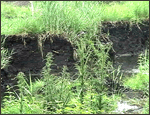 Neydharting is not the only source of moor in the world. In fact, most continents have examples of moors or 'peat bogs'. Emphasis should be placed however, on the many differences that exist between them. First, we must consider their composition. In most examples found throughout the world, moors are comprised of decayed trees, shrubs, grasses, and flowers. Had these moors been subjected to a greater period of decomposition and situated deeper in the earths crust, the immense pressure would have turned this peat to coal - fossilised trees, etc. On the other hand, some peat moors located across the northern band stretching from Ireland, England, and Holland are comprised of thick grasses, reeds, shrubs, and grain crops. These are primarily 'low moors' or 'fens', derived from sunken fields or swamps. They are richer in enzymes and minerals, and are the places where the many cases of preserved corpses have been documented - bodies buried for hundreds of years which have yielded the most perfect examples of natural preservation. Apart from specific composition, the distinction between 'low moors' and 'high moors' is also important. High moors are usually drier and by comparison to low moors, depleted of many of the minerals and enzymes they once may have possessed. Low moors or 'fens' have a much higher percentage of water content, which suspends enzymes, minerals, and trace elements. Neydharting is not the only source of moor in the world. In fact, most continents have examples of moors or 'peat bogs'. Emphasis should be placed however, on the many differences that exist between them. First, we must consider their composition. In most examples found throughout the world, moors are comprised of decayed trees, shrubs, grasses, and flowers. Had these moors been subjected to a greater period of decomposition and situated deeper in the earths crust, the immense pressure would have turned this peat to coal - fossilised trees, etc. On the other hand, some peat moors located across the northern band stretching from Ireland, England, and Holland are comprised of thick grasses, reeds, shrubs, and grain crops. These are primarily 'low moors' or 'fens', derived from sunken fields or swamps. They are richer in enzymes and minerals, and are the places where the many cases of preserved corpses have been documented - bodies buried for hundreds of years which have yielded the most perfect examples of natural preservation. Apart from specific composition, the distinction between 'low moors' and 'high moors' is also important. High moors are usually drier and by comparison to low moors, depleted of many of the minerals and enzymes they once may have possessed. Low moors or 'fens' have a much higher percentage of water content, which suspends enzymes, minerals, and trace elements.
|
 |
a long history of health benefits! |
|
Whatever type, moors have long been valued for the many uses they have offered man over the centuries. But understanding the differences between some of the broader types, it is not surprising that fens have been chosen specifically for curative application. Their high concentration of bio-degraded minerals and trace elements make them a suitable alternative to volcanic clays which comprise only inorganic minerals, and offer up only mechanical action on the skin, but possess no capacity to penetrate, nor contribute to the supply of minerals required by the body. Since minerals which have not been synthesised by plants cannot be digested or used by the body, the Neydharting Moor provides a viable source of necessary minerals and trace elements for our diet.
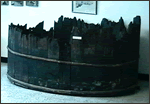 Imagine the fascination of Renaissance alchemist Paracelsus, when he became the first person recorded to have recognised that the fen of Neydharting, which had been discovered by the Celts and was recorded to have been recognised for it's remarkable curative effects since 800 B.C., was actually comprised primarily of herbs - as opposed to shrubs and grasses. Not only was the Neydharting Moor rich in organically synthesised minerals and trace elements, but theirs was the greatest source of all - herbs. And therefore, following his theory of "potency" or concentration, also contained a more powerful form of the unique enzymes and essences of the magnificent botanical healers - in a highly assumable state. And so, beginning with the work of Paracelsus - one of the pioneers of chemistry and modern medicine, we get a glimpse into what lies behind the legend that has surrounded Neydharting for over twenty nine centuries. A legend born not only of the Celts, but of the testimony of countless generations, and the notables Paracelsus, Napoleon and Josephine, Louis XIV, Sebastian Kneipp, and most recently hundreds of doctors, professors, and scientists associated with the International Moor Research Institute. Imagine the fascination of Renaissance alchemist Paracelsus, when he became the first person recorded to have recognised that the fen of Neydharting, which had been discovered by the Celts and was recorded to have been recognised for it's remarkable curative effects since 800 B.C., was actually comprised primarily of herbs - as opposed to shrubs and grasses. Not only was the Neydharting Moor rich in organically synthesised minerals and trace elements, but theirs was the greatest source of all - herbs. And therefore, following his theory of "potency" or concentration, also contained a more powerful form of the unique enzymes and essences of the magnificent botanical healers - in a highly assumable state. And so, beginning with the work of Paracelsus - one of the pioneers of chemistry and modern medicine, we get a glimpse into what lies behind the legend that has surrounded Neydharting for over twenty nine centuries. A legend born not only of the Celts, but of the testimony of countless generations, and the notables Paracelsus, Napoleon and Josephine, Louis XIV, Sebastian Kneipp, and most recently hundreds of doctors, professors, and scientists associated with the International Moor Research Institute.
But perhaps the greatest testimony is the very fact that this unusual black substance has stood the test of time, long after countless other remedies have faded into obscurity. Even with the advent of modern technology, science has not even come close to fully understanding it, let alone duplicating its action. |
| |
|
|